School Admin? Schedule a demo

Number Bonds and Times Tables Mastered Through Strategy, Not Rote Memorisation.

A strategy-based approach to maths fluency and mental recall.

A Strategy-First Approach to Maths Mastery

MathFactLab was created by a teacher to put the latest research in mathematics education into practice. Our platform provides online number facts fluency practice that focuses entirely on reasoning strategies and sense-making.
While many maths programmes rely on "drill and kill" methods and rote memorisation, MathFactLab focuses on building a foundation of mental recall through genuine understanding.
Our pupils aren't expected to blindly memorise equations. Instead, they engage with powerful visual models—including number lines, area models, bar diagrams, ten frames, and Rekenreks. By exploring these representations, students develop the number sense necessary to master number bonds and times tables for the long term.
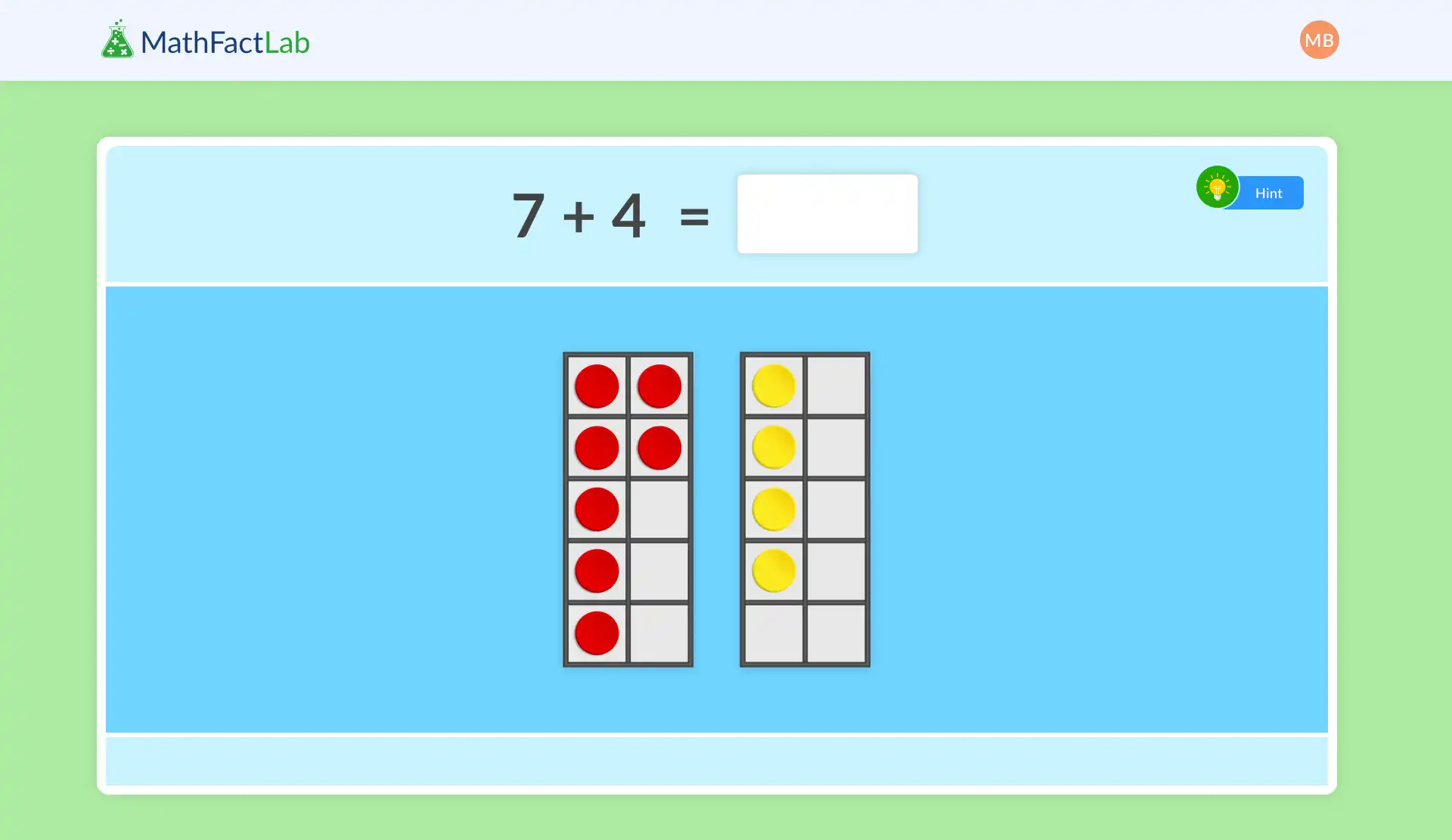
MathFactLab addition fact problem 7 plus 4 equals with ten-frame visual aids showing seven red dots and four yellow dots.
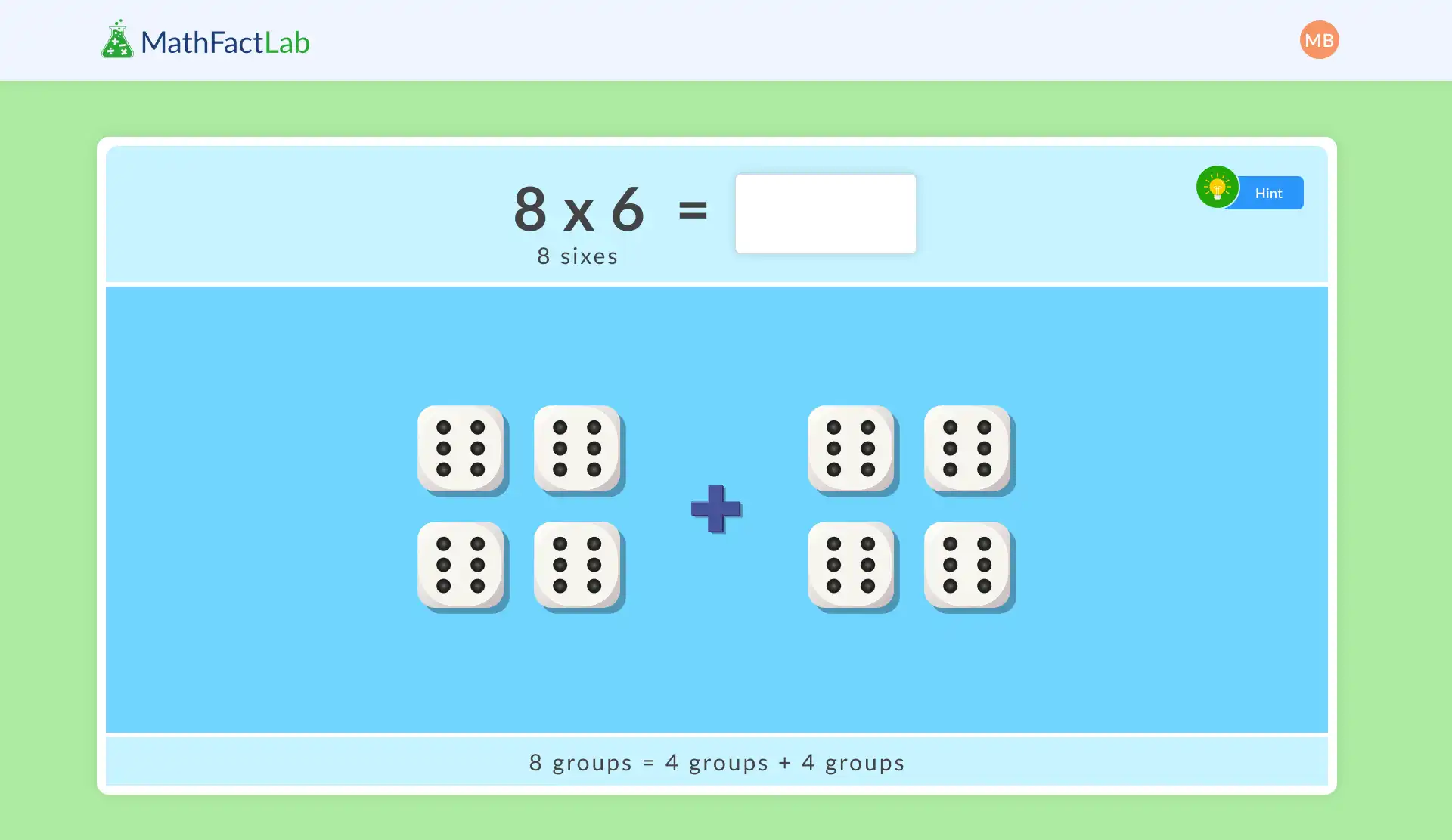
MathFactLab multiplication fact problem showing 8 times 6 equals blank with illustration of eight dice showing six dots grouped as two sets of four dice plus sign between them, and text reading '8 groups = 4 groups + 4 groups'.
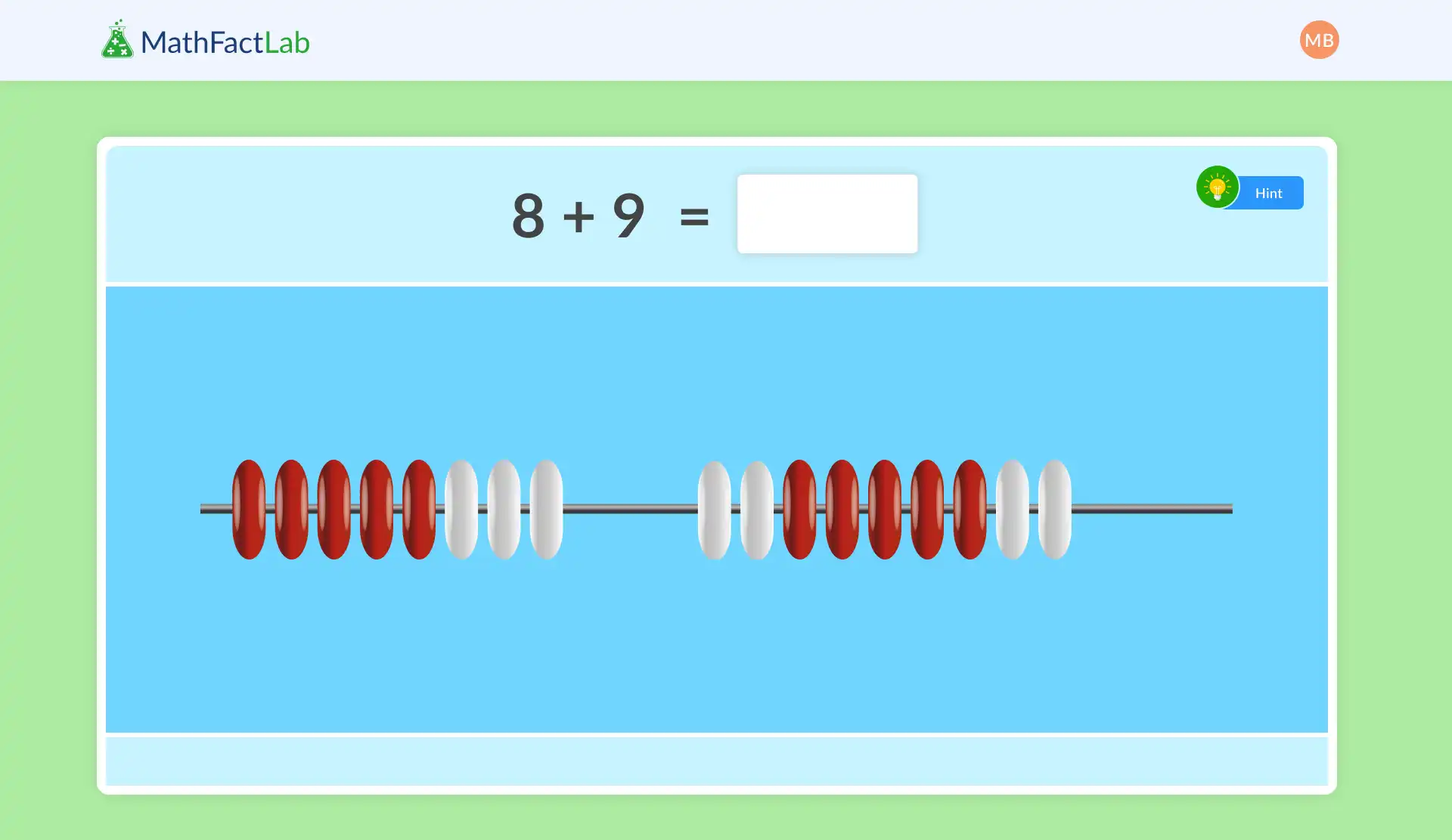
MathFactLab addition fact problem 8 plus 9 equals with a rekenrek or number rack showing 17 beads.
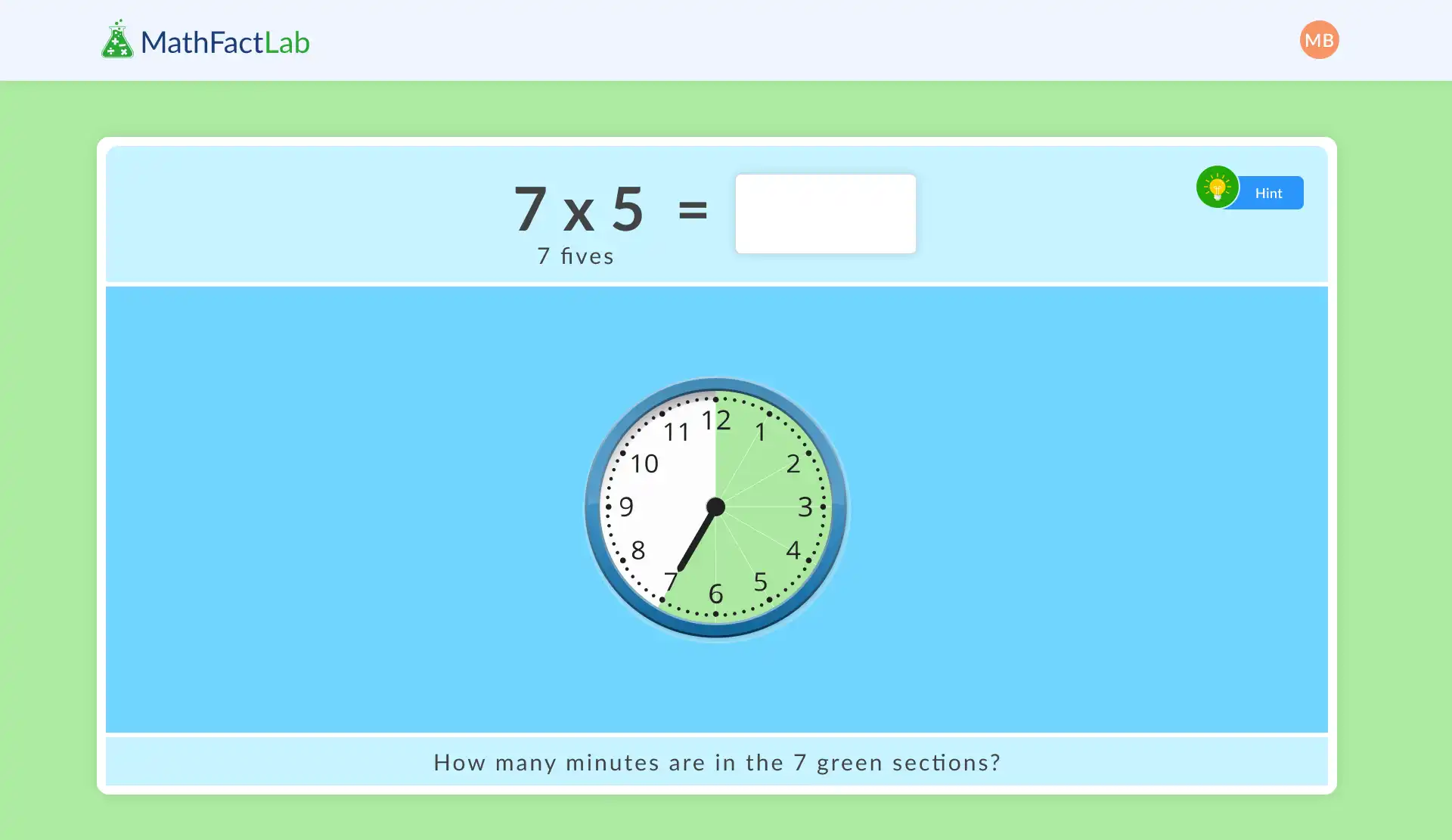
Online multiplication fact practice problem 7 x 5 with a clock showing 7 green sections representing 35 minutes, asking how many minutes are in the 7 green sections.
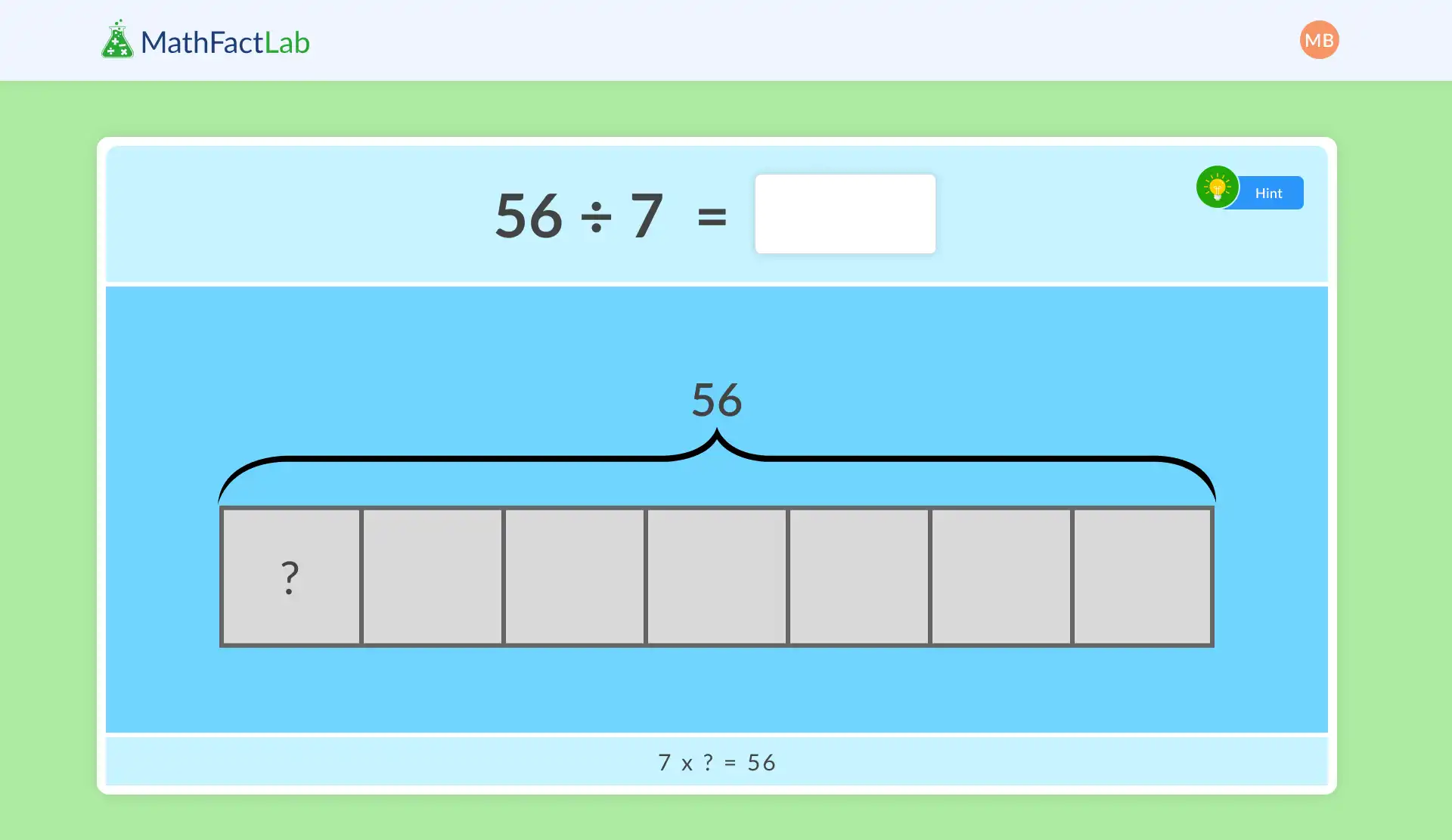
MathFactLab division fact practice problem 56 ÷ 7 with seven empty boxes representing equal parts, showing 7 times a missing number equals 56.
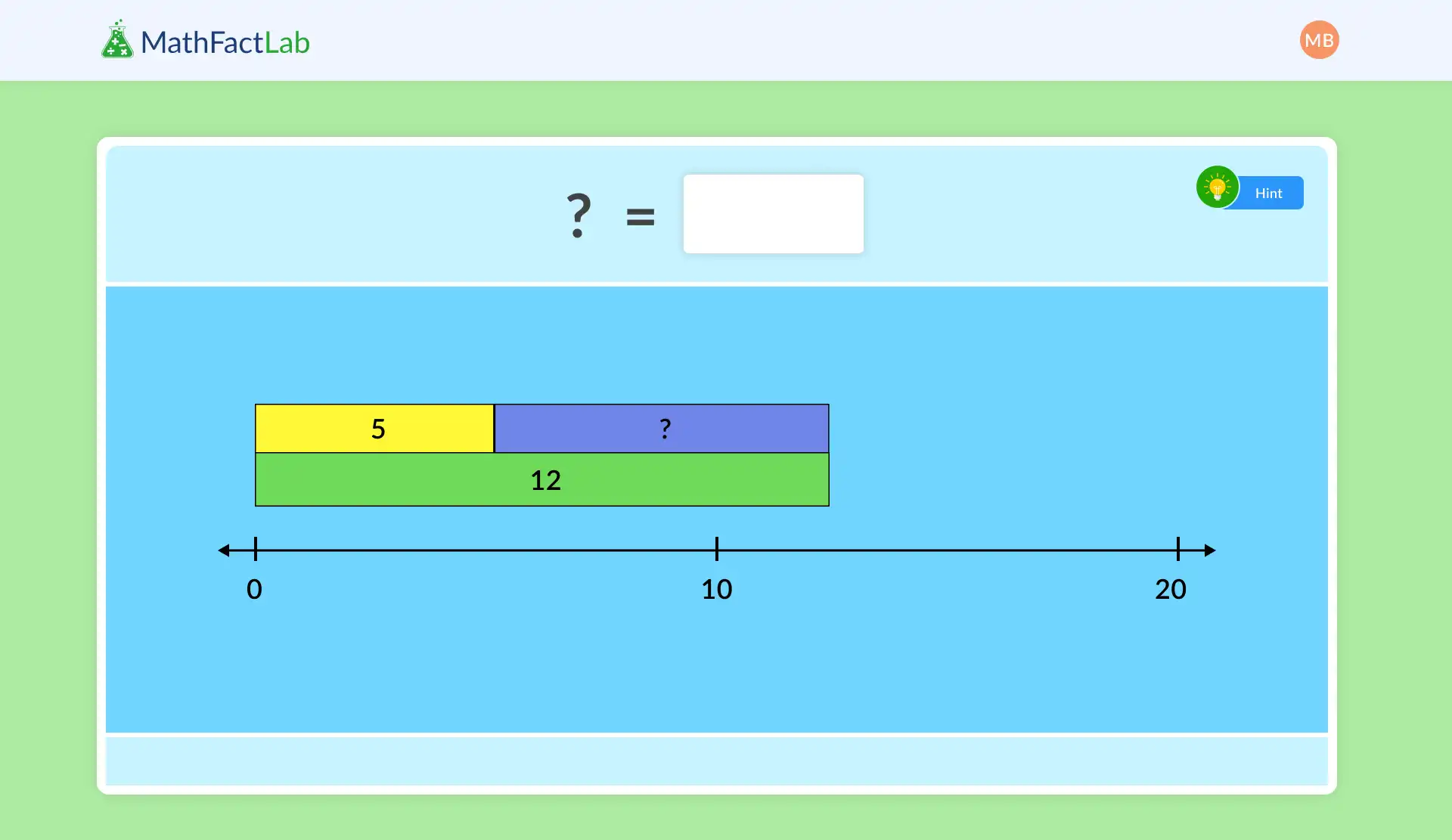
MathFactLab number line representing a x5 fact familiy segments 5 and unknown length adding to 12, with zero, 10, and 20 marked on the line.
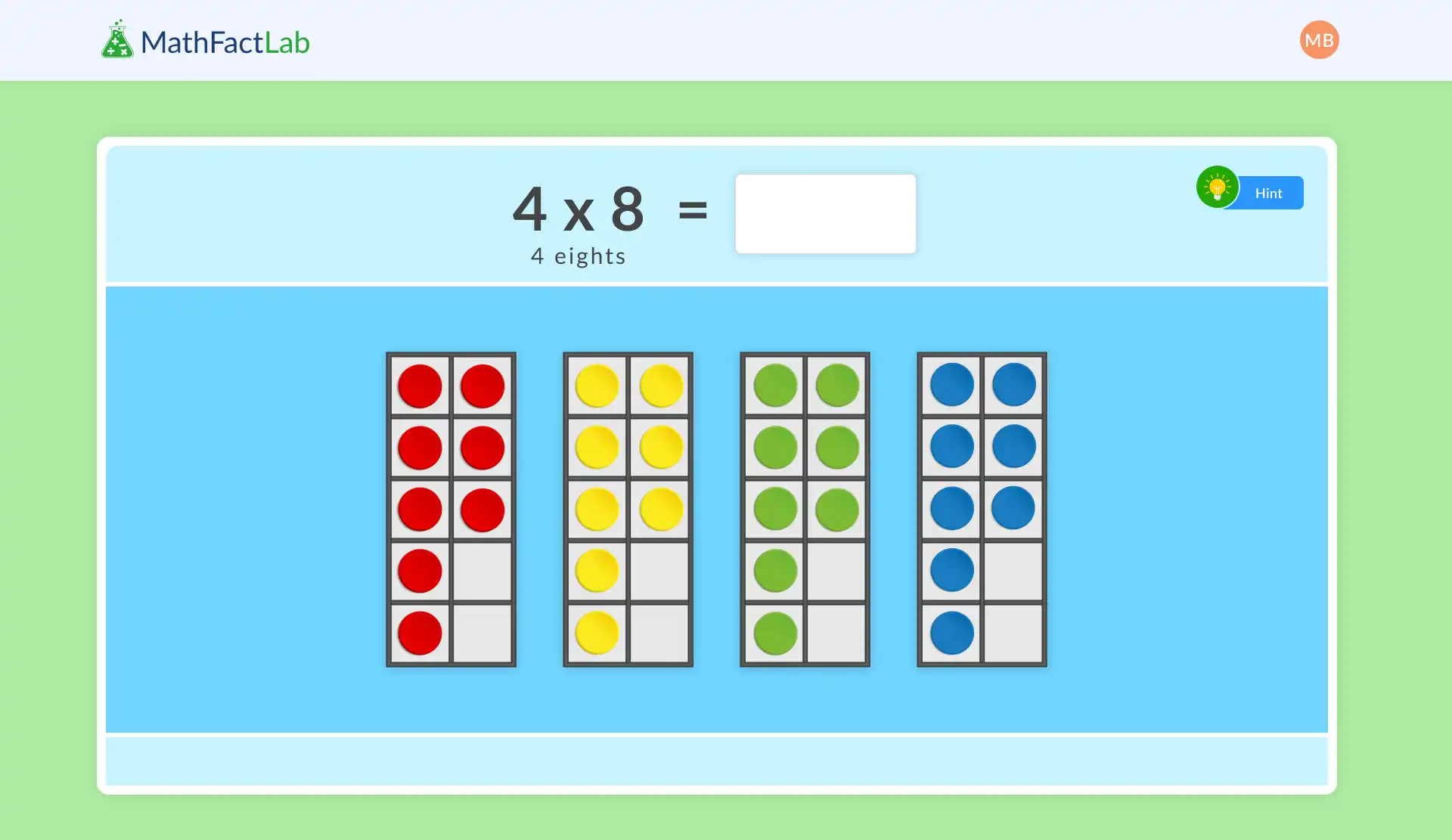
MathFactLab multiplication fact practice question showing 4 x 8 with four ten-frames filled with red, yellow, green, and blue counters.
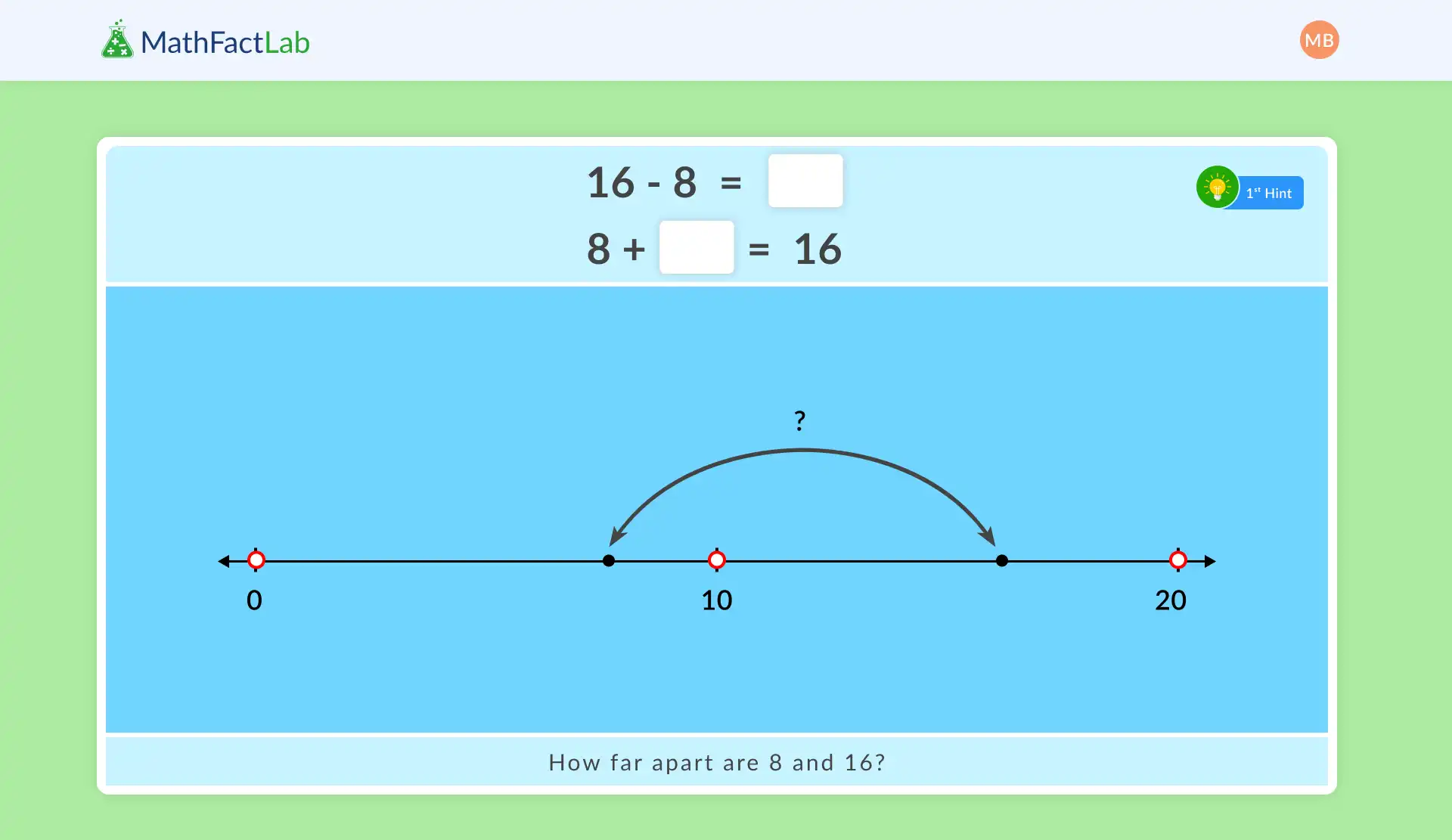
MathFactLab screen showing subtraction fact and addition fact problem with blanks, a number line from 0 to 20, and a question mark indicating distance between numbers 8 and 16.
MathFactLab division fact practice showing 42 divided by 7 with blank answer boxes and a fact family triangle with numbers 42, 7, and a question mark.
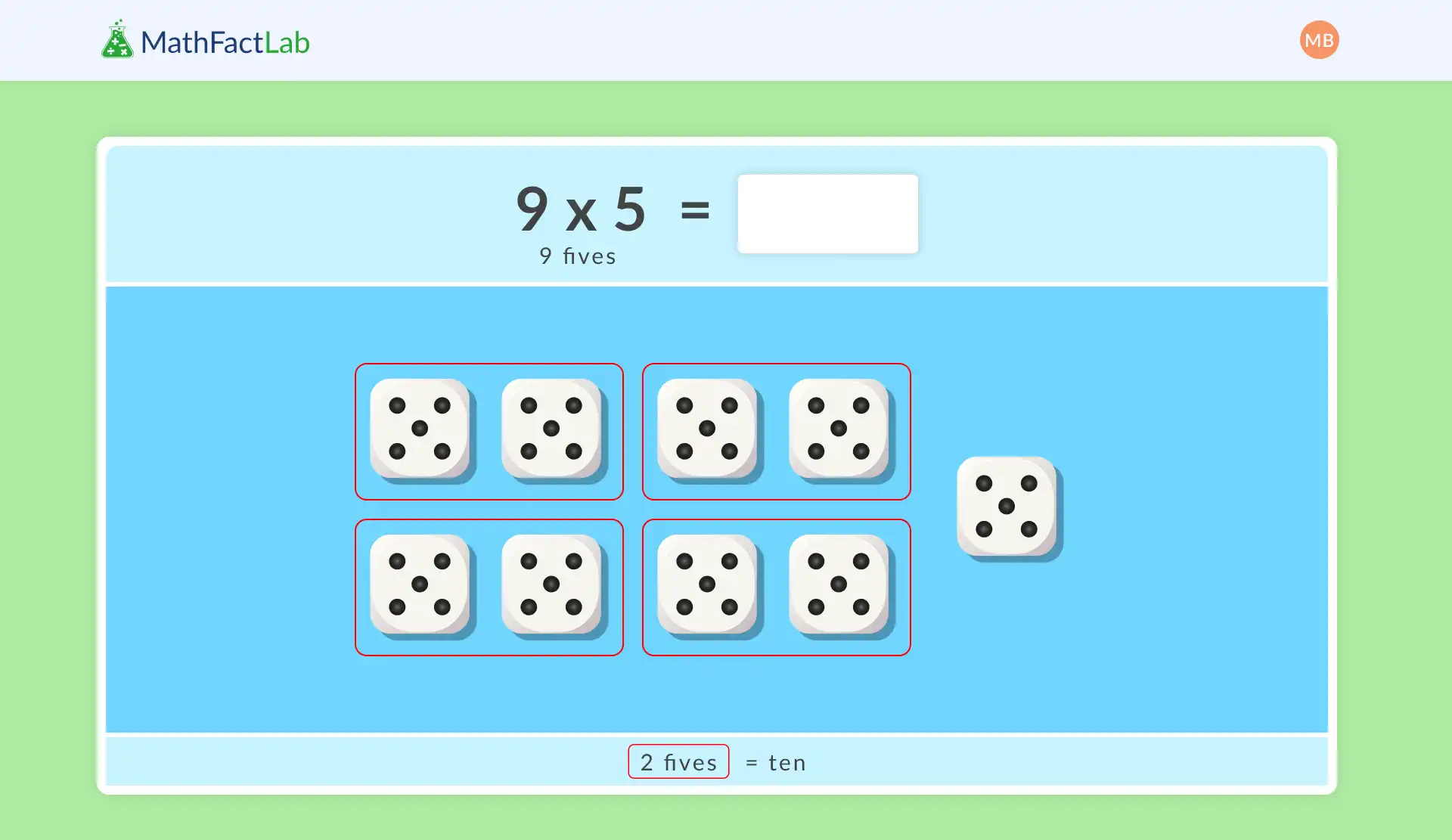
MathFactLab multiplication exercise showing 9 times 5 with groups of five dice arranged in fours and one single die, illustrating 9 fives.
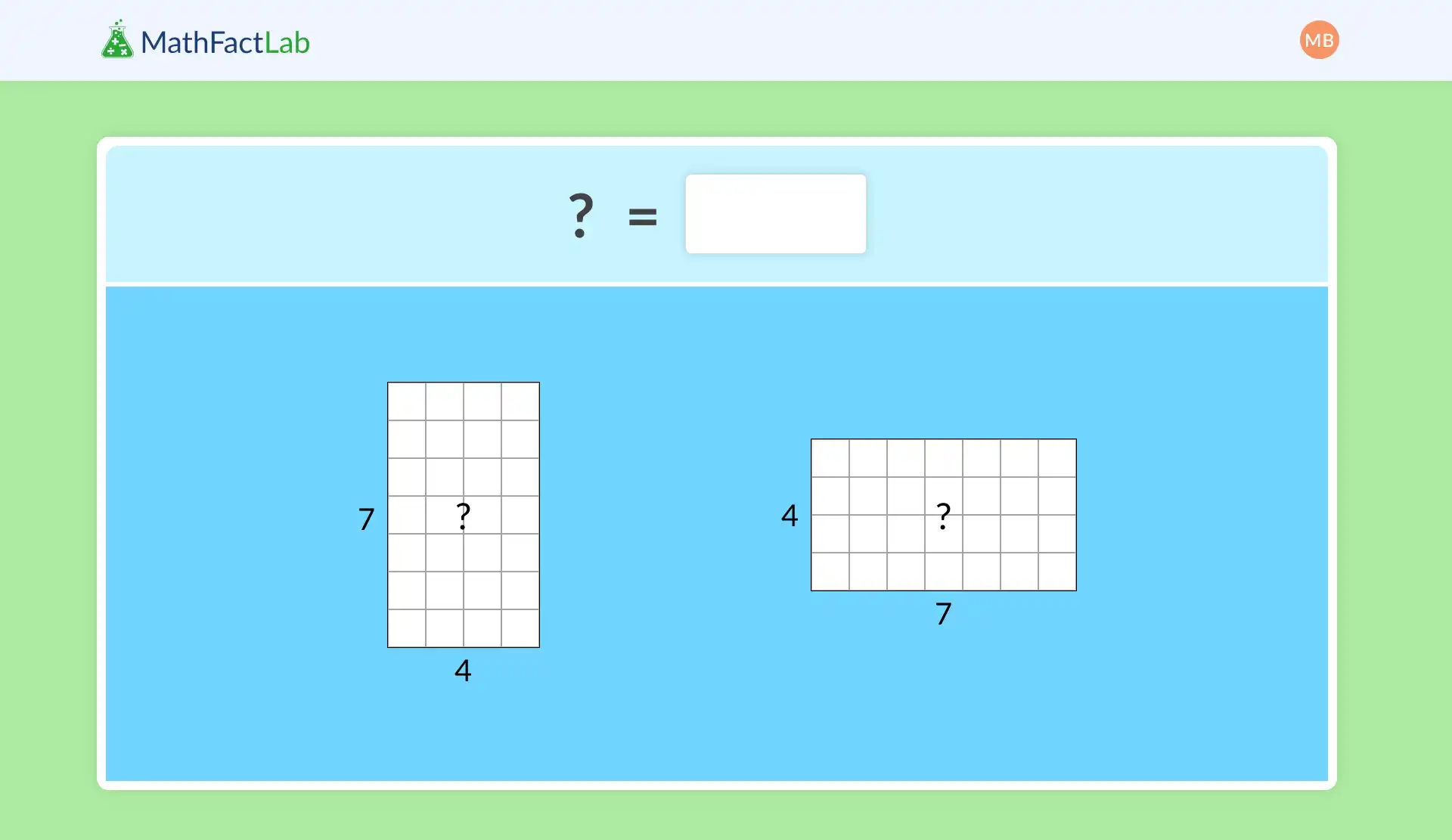
MathFactLab multiplication fact practice showing two rectangles with grid lines, one vertical 7 by 4 and one horizontal 4 by 7, asking for their area equivalence with a blank answer box.
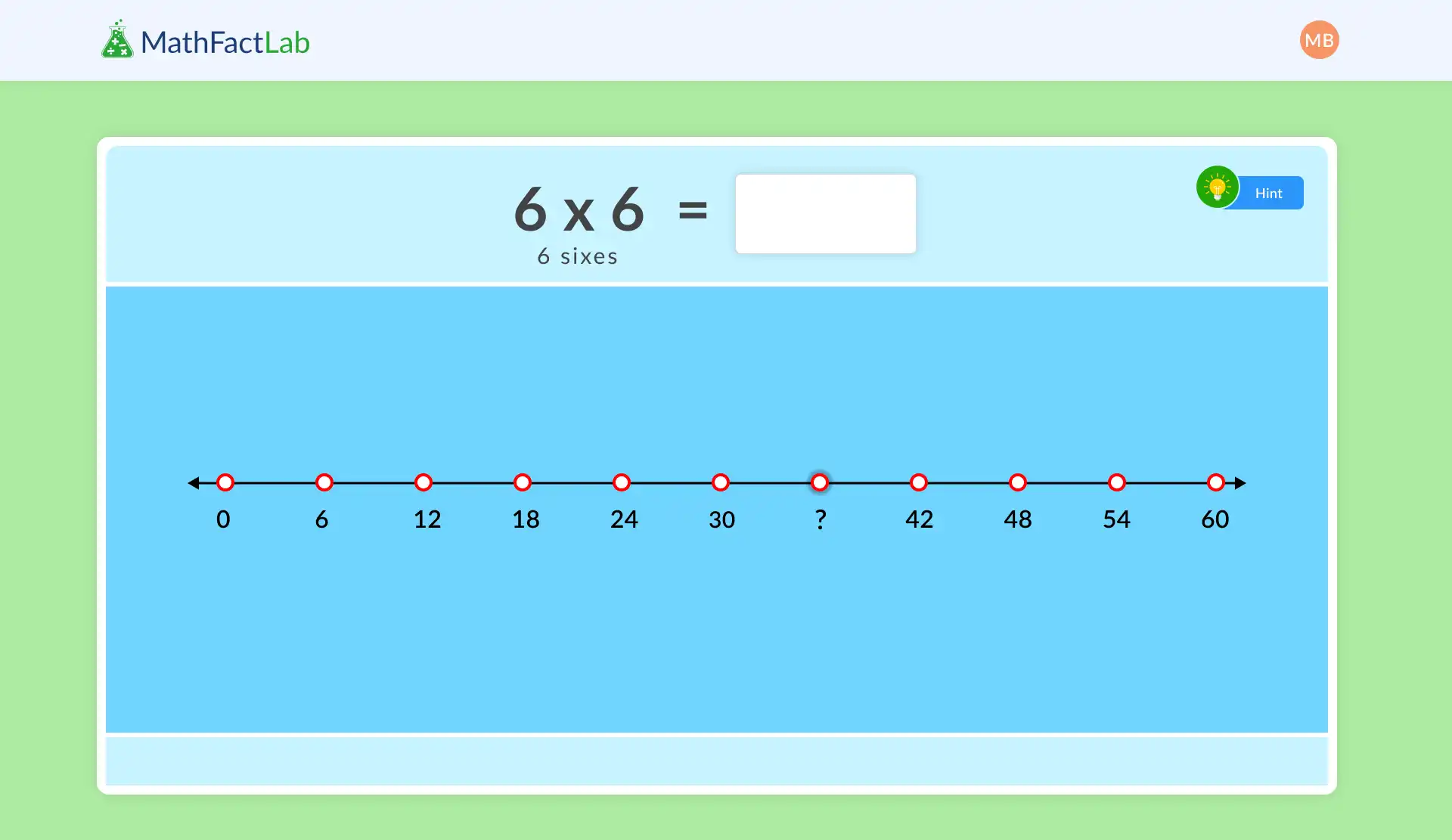
MathFactLab multiplication fact 6 x 6 with a number line showing multiples of 6 from 0 to 60, missing 36 at the question mark.

Developing Fluency through Mathematical Reasoning

At MathFactLab, we believe that true fluency is built on a deep understanding of how numbers relate. We represent basic number facts through a diverse range of visual models, allowing pupils to see the connections between operations. This helps them recognise addition, subtraction, multiplication, and division as interconnected fact families rather than isolated equations.
When practising times tables and division facts, for instance, learners explore representations like open arrays, area models, and bar diagrams. By using these mental strategies, pupils discover how to derive new facts from those they already know—moving them from heavy cognitive load to effortless recall.

Mastering Number Facts Through Visual Representation

When pupils work on addition and subtraction fluency, they engage with ten frames, Rekenrek beads, number lines, and bar models. These visual aids help them recognise that numbers aren't isolated, but part of interconnected fact families. By understanding these relationships, the task of mastering basic number bonds becomes far more manageable and intuitive.
Regular use of these models allows learners to build robust mental images, deepening their conceptual understanding of the four operations. Multiplication and division are no longer seen as separate hurdles but as inverse operations—two sides of the same coin. This foundation is essential for developing overall maths fluency.
As pupils practise their number facts online with MathFactLab, they begin to spot the patterns and links that define our number system. This leads to swifter mastery, boosted confidence in the classroom, and significantly improved outcomes in primary mathematics.
Primary teachers: whether your pupils are developing foundational number bonds or tackling their multiplication tables, MathFactLab provides the strategy-led support they need to succeed in maths.
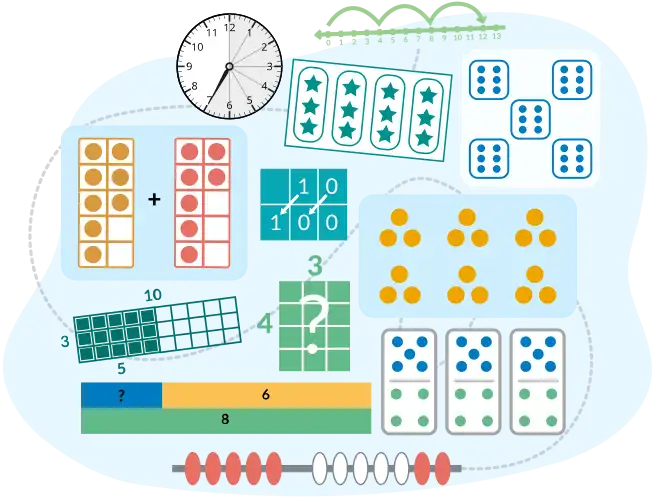
Collage of math learning tools including an analog clock showing 8:23, number blocks, dice, abacus, star cards, and a number line with addition and question marks.

You’ll Love MathFactLab

It's easy. Get your class started in minutes.
Student practicing math facts.
Adjust settings to match the specific pace  of every learner.
Customise accessibility to ensure success for all.
Enhance your classroom teaching with individualised, maths fluency practise. Our approach develops a broad spectrum of core mathematical concepts and skills.
MathFactLab automatically assesses each pupil, ensuring they are placed at the perfect starting point within our number facts or times table programmes.
Track progress across all year groups using our intuitive dashboard. Identify at a glance which pupils require additional support or specific interventions.
Boost learner confidence as pupils take pride in their progress and celebrate their growth through every stage of the curriculum.

What the Research Says

The best way to develop fluency with numbers is to develop number sense and to work with numbers in different ways, not to blindly memorize without number sense.
- Jo Boaler
Stanford University Professor of Mathematics Education and Co-Founder of You cubed, in her article Fluency Without Fear: Research Evidence on the Best Ways to Learn Math Facts
Many studies over many years have compared traditional basic fact instruction (i.e., drill) to strategy- focused instruction. All of them show that strategy groups outperform their peers on using strategies and on automaticity and accuracy.
- Jennifer Bay-Williams & Gina Kling
Math Fact Fluency: 60+ Games and Assessment Tools to Support Learning and Retention. citing research from Baroody, Pupura, Eiland, Reid, & Paliwal, 2016; Brendefur, Strother, Theide, & Appleton, 2015; Locuniak & Jordan, 2008; Purpura, Baroody, Eiland, & Reid, 2016; Thornton, 1978, 1990; Tournaki 2003
Fluency includes accuracy, efficiency, flexibility, and the selection of appropriate strategies. Pupils progress through phases: counting, then deriving, and finally mastery. The most effective approach requires pupils to master number relationships before moving to automaticity.
- Mark McCourt
Teaching for Mastery, 2019
Research supports the use of explicit strategy instruction as effective in helping all students learn (and remember) their basic math facts (e.g.,Baroody, et al., 2009; Baroody, et al., 2016; Thornton, 1978; Fuson, 1992; Rathmell, 1978; Thornton & Toohey, 1984).
- John A. Van de Walle, Karen S. Karp & Jennifer Bay-Williams
In Elementary and Middle School Mathematics: Teaching Developmentally, 2019