The 10 Times Table: How to Teach x10 Multiplication Facts
August 28, 2025
4
minute read
The 10 times table is the next set of facts for students to learn after getting the x2 facts under their belt. Students learn the x10 multiplication facts at Level B in MathFactLab's Multiplication & Division program, and it generally takes very little time for students to master them.
Don't Add Zero!
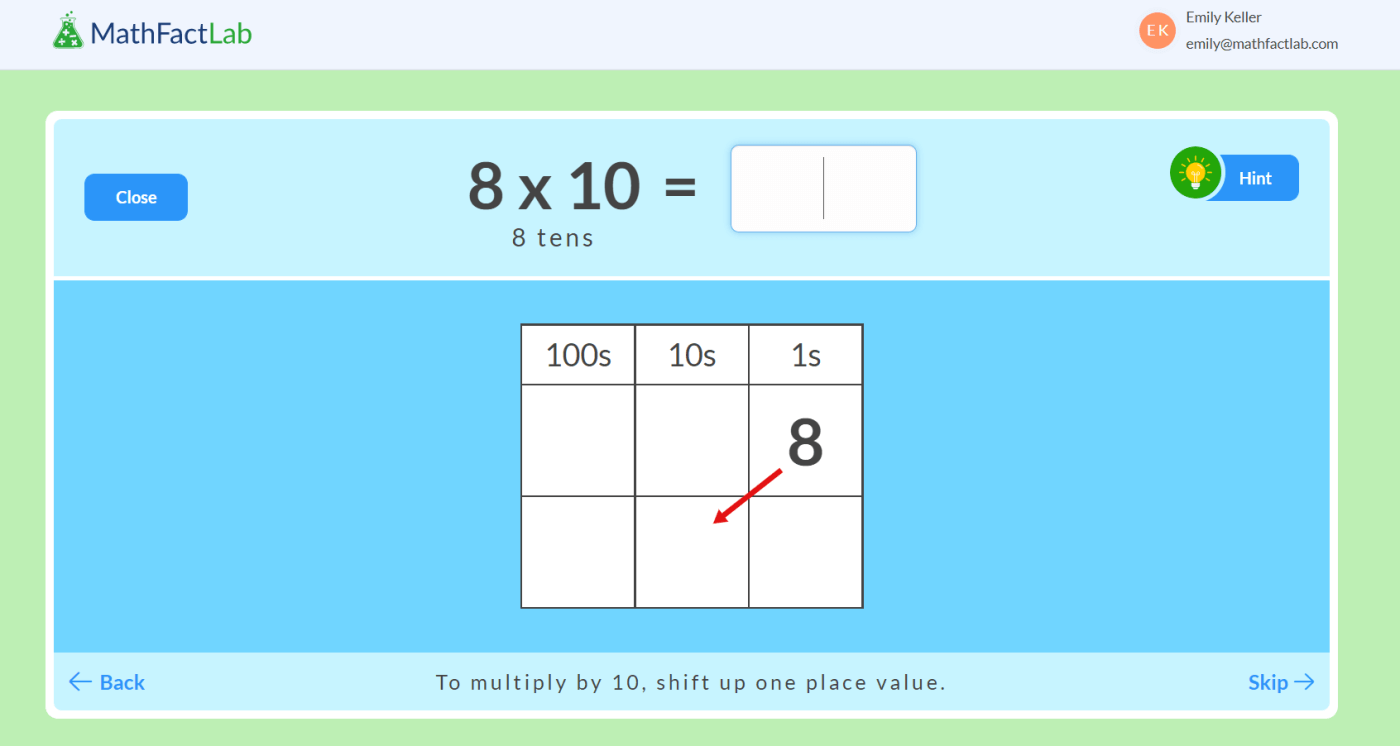
While solving x10 facts may not be difficult, it's important for teachers and parent to use accurate mathematical language when teaching these facts. Avoid using language that involves the phrase, 'Add zero'. Instead, let learning to multiply by ten be an opportunity for students to gain a better understanding of the place value system.
We want students to recognize that any time we shift the digits of a number up one place value, the number's value increases by ten. While learning to multiply by 10 is a third grade standard, when we teach it in terms of place value, we are preparing our students to better understand the below fourth and fifth grade standards. That way, a student can take a number with digits in the decimal places and multiply it by ten just as easily as if it were a whole number. Try adding a zero to 8.05! 8.050 is certainly not ten times bigger.
Generalize place value understanding for multi-digit whole numbers.
CCSS.MATH.CONTENT.4.NBT.A.1Recognize that in a multi-digit whole number, a digit in one place represents ten times what it represents in the place to its right.
Understand the place value system.
CCSS.MATH.CONTENT.5.NBT.A.1Recognize that in a multi-digit number, a digit in one place represents 10 times as much as it represents in the place to its right and 1/10 of what it represents in the place to its left.
When students think of multiplication by ten (or powers of ten) as shifting digits to the left, it is only a small step to for them to realize that dividing by powers of ten can be accomplished by shifting to the right.
Why x10 Multiplication Facts are 'Foundational'
The foundational multiplication facts are the x2, x10, x5 and x1 facts and are taught it the first four levels of MathFactLab. They are foundationals, because they are the building blocks of the other basic math facts. x2 facts can be doubled to learn the x4 facts. Add the x1 facts to the x2 facts and you have the x3 facts.
One strategy for learning the x5 facts is to chop the x10 facts in half. Take one group away from ten groups, and you have nine groups. Thus, two other sets of facts can be easily learned by using the x10 facts as a foundation.
Other Models for the 10 Times Table
At MathFactLab, we always like have our students be able to visualize any fact in multiple ways. While the place-value method is definitely the first port of call for x10 multiplication, we also use number lines and area models too.
Dividing by 10 or Dividing a Multiple of 10
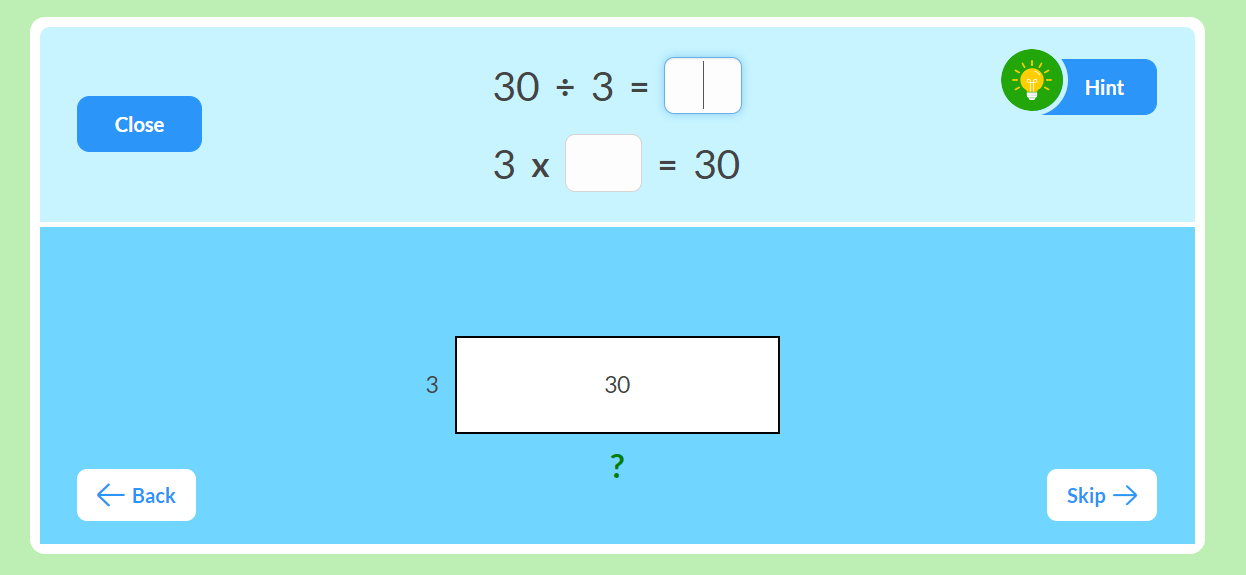
Ultimately, we want students to recognize that to divide by ten, one just needs to shift down a place value. We also want them to recognize that they can always use their multiplication facts to help them solve division fact problems. Notice that both of the images below encourage students to think multiplication as they try to solve the division facts.
When kids tell me, 'I can't do division,' I remind them that they know their multiplication facts, and so they just need to 'un-multiply'. When this sinks in, division of already-mastered multiplication facts is a breeze.
This blog was written by Mike Kenny, fifth-grade math teacher and creator of MathFactLab.