Practice should focus on making reasoning strategies more automatic, not on drilling isolated facts.
- Arthur J. Baroody
Most online math fact practice is based on drill. Think of math facts drills as repeated practice without reasoning strategies or context. Drill might come in paper-and-pencil form, such as 'Mad Minutes', or in multiple forms on the internet. If you peruse the math fact websites across the internet you'll find that drill is essentially their only instructional strategy. MathFactLab is different.
Why doesn't drill work? According to Baroody (2006, pg 22), there are three phases to math fact fluency development.
Phase 1: Counting strategies - using object counting (e.g., with blocks, fingers, marks) or verbal counting to determine an answer
Phase 2: Reasoning strategies - using known information (e.g., known facts and relationships) to logically determine (deduce) the answer of an unknown combination
Phase 3: Mastery - efficient (fast and accurate) production of answers
Drill focuses on Phase 3 without developing the strategic reasoning of Phase 2. Jennifer Bay-Williams and Gina Kling, in their excellent book, Math Fact Fluency: 60 Games, explain the problem with this:
Students subjected to such programs may appear to know the facts in the short term, but within weeks or months they are back to where they started: counting. Because little to no time is spent in Phase 2, once facts are forgotten, students have no efficient, appropriate, and flexible strategies to fall back on.
- Jennifer Bay-Williams and Gina Kling
At MathFactLab, we prefer not to take shortcuts. Instead, we help our students to develop a solid array of strategies for each level of our program. Only when those strategies are efficiently internalized (Phase 3!), do students move on to the next level.
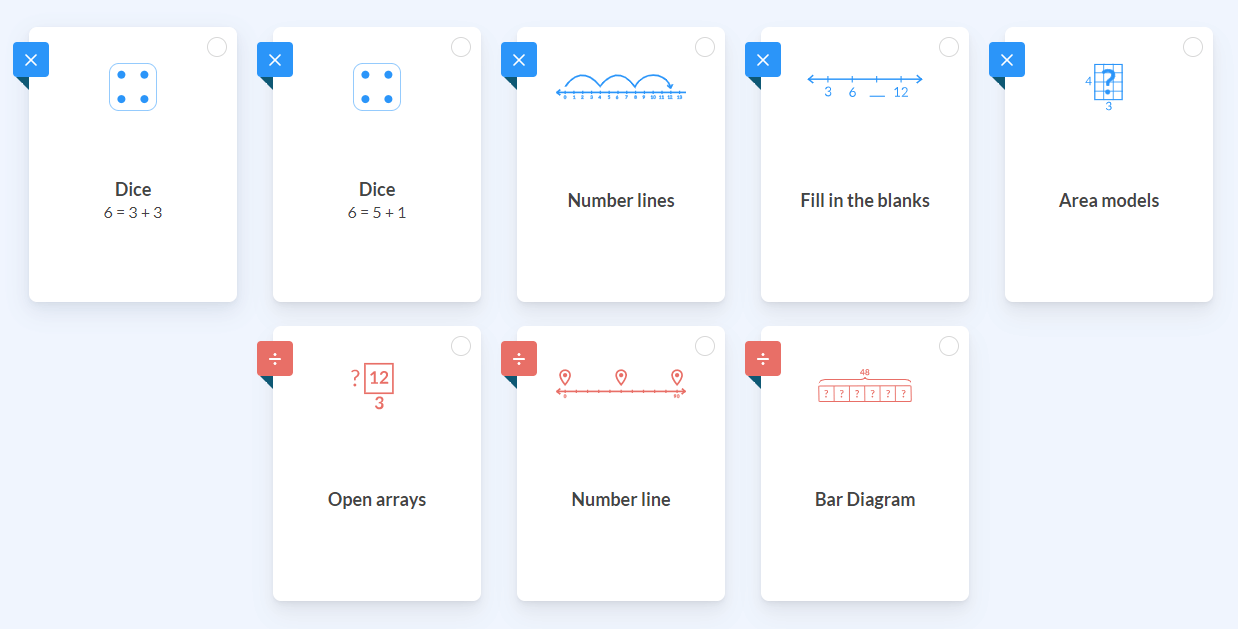
What do we mean by strategies? Our students practice with a variety visual representations of each problem, whether it be with ten frames, dice, number lines, area models, bar diagrams or other approaches.
I am confident that this focus on Phase 2 leads to Phase 3's mastery. I have seen this happen over and over again with my own students, as I am sure you will too when you incorporate MathFactLab into your classroom instruction.
-Baroody, A. J. (2006). Why Children Have Difficulty Mastering the Basic Number Combinations and How to Help Them. Teaching Children Mathematics, 13(1), 22-31.
-Bay-Williams, J., & Kling, G. (2019). Math Fact Fluency: 60+ Games and Assessment Tools to Support Learning and Retention. ASCD.
This blog post was written by Mike Kenny, fifth-grade math teacher and creator of MathFactLab.