At MathFactLab, our students study multiplication facts and division facts simultaneously. This approach harnesses the power of multiplication/division fact families, helping students to understand the relationships between these inverse operations.
With sufficient practice, our students will develop a flexible fluency with all of the facts on the multiplication timestable, either in division or multiplication form.
MathFactLab's Multiplication and Division Fact Program
The Learning Sequence
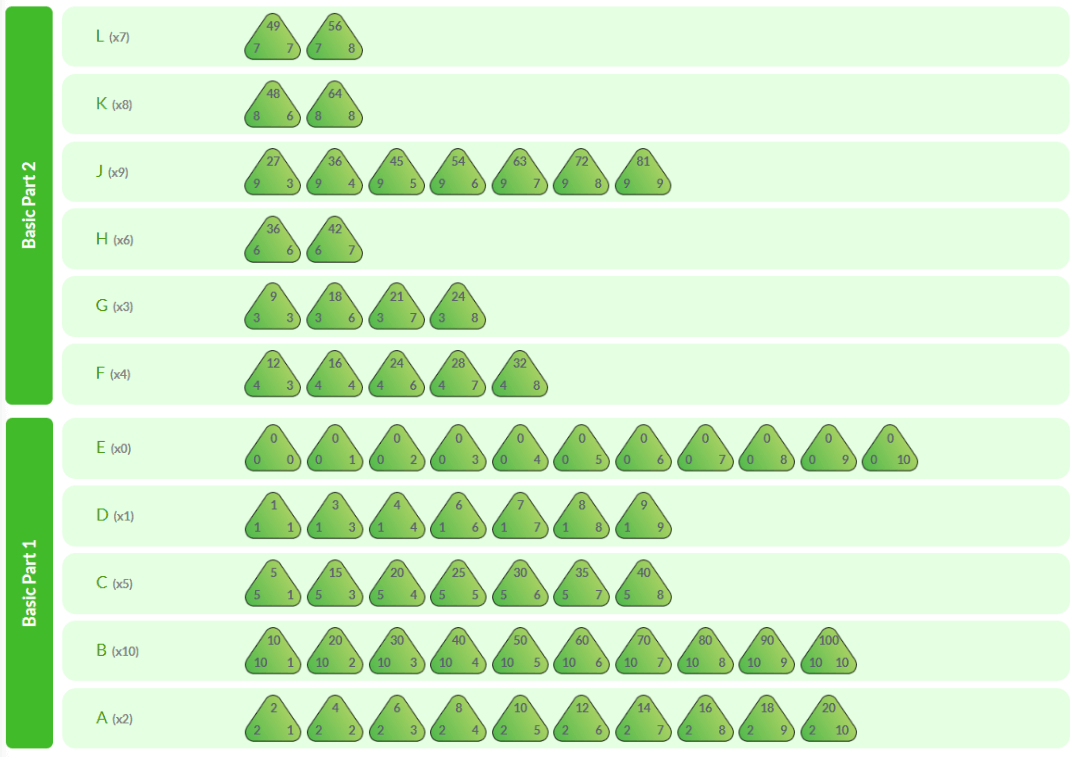
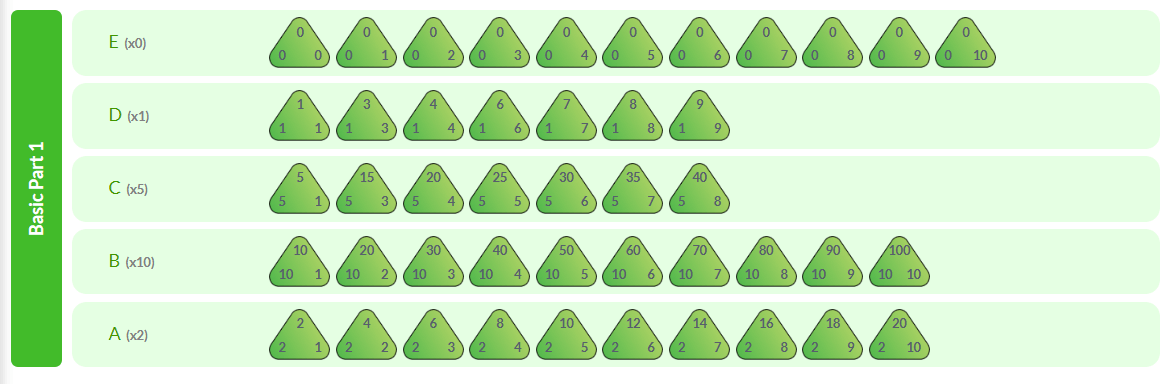
Students in our multiplication facts - division facts program progress through a series of eleven levels, beginning with the foundational stage:
Level A (x2)
Level B (x10)
Level C (x5)
Level D (x1)
Level E (x0)
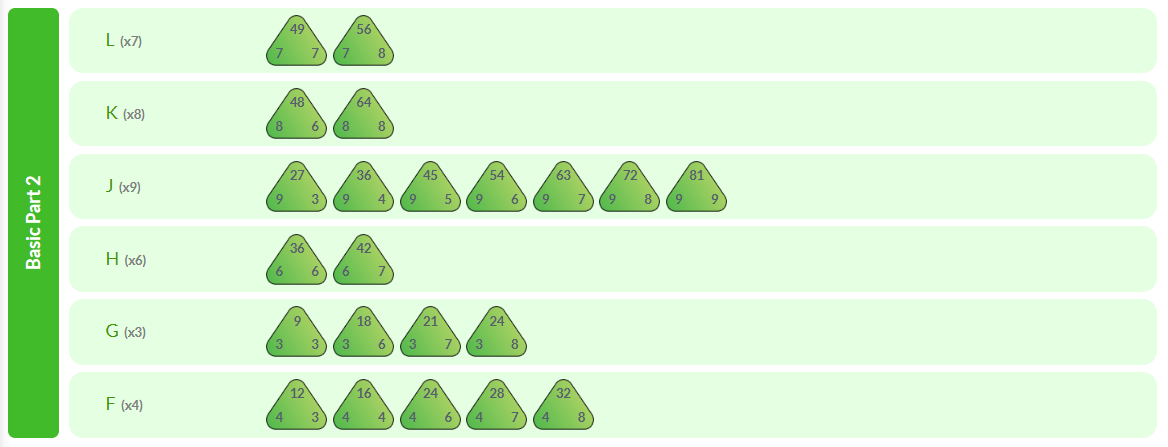
With these foundational facts under their belt, students then move on to the derived facts:
Level F (x4)
Level G (x3)
Level H (x6)
Level J (x9)
Level K (x8)
Level L (x7)
Our Models and Strategies
At each level, students work through a menu of strategies, most focusing on division or multiplication, while a few work on both operations simultaneously.
The primary models used in the multiplication and division program are dice, number lines, area models, and bar diagrams. Number lines and open arrays are used to represent both multiplication and division problems. Dice, ten frames and area models represent multiplication problems. Bar diagrams and open arrays represent division problems.
Other models are used only on particular levels. For example, ten frames (x2, x3 & x4); place-value charts (x10); clock faces (x5); and number patterns (x9). More models are on the way.
Promotion
When students have demonstrated a degree of competence with the facts and strategies at a given level, they opt to take the 'Level Lifter' where no strategies or models are provided. If students successfully complete the Level Lifter, they are ready to move onto the next level.
Beyond the Basics
MathFactLab also offers strategy-based advanced, super-advanced and super-duper-advanced multiplication and division stages.
In the advanced program multiplication and division stage, students learn x11 and x12 facts, up to 12x12. These are Levels M (x11) and N (x12).
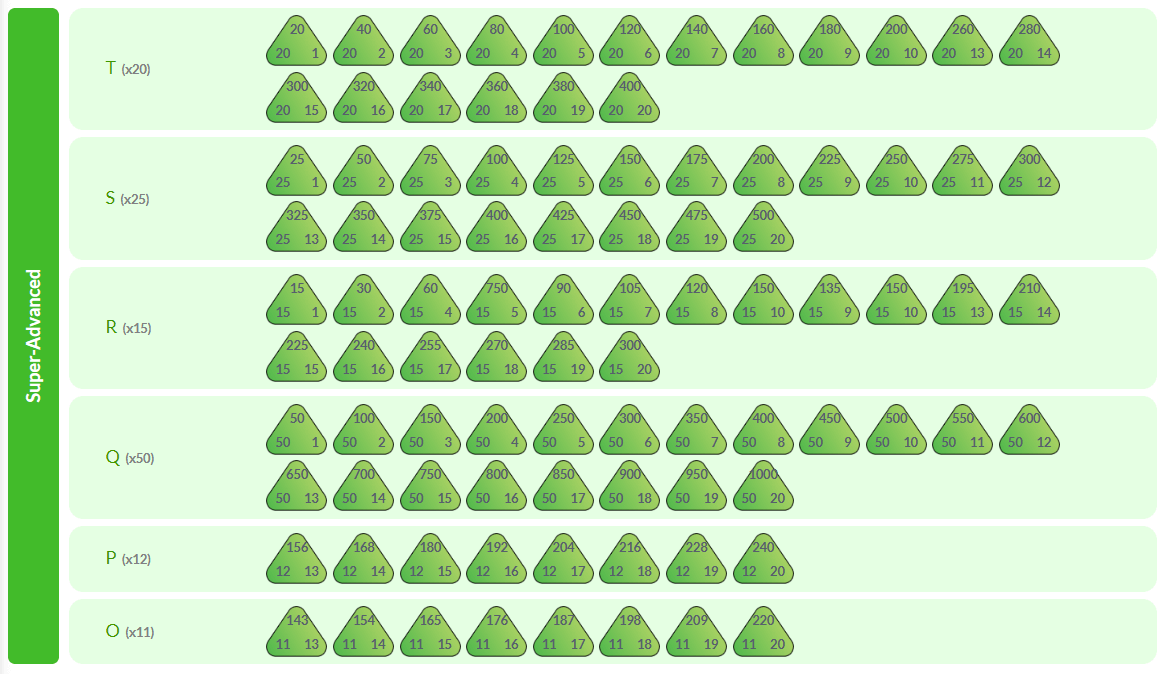
In the super-advanced multiplication stage, students extend their knowledge of elevens and twelves up to 12x20. They then go beyond tradition by working on strategies to develop fluency with x50, x15, x25 and x20 facts, again up to __x20.
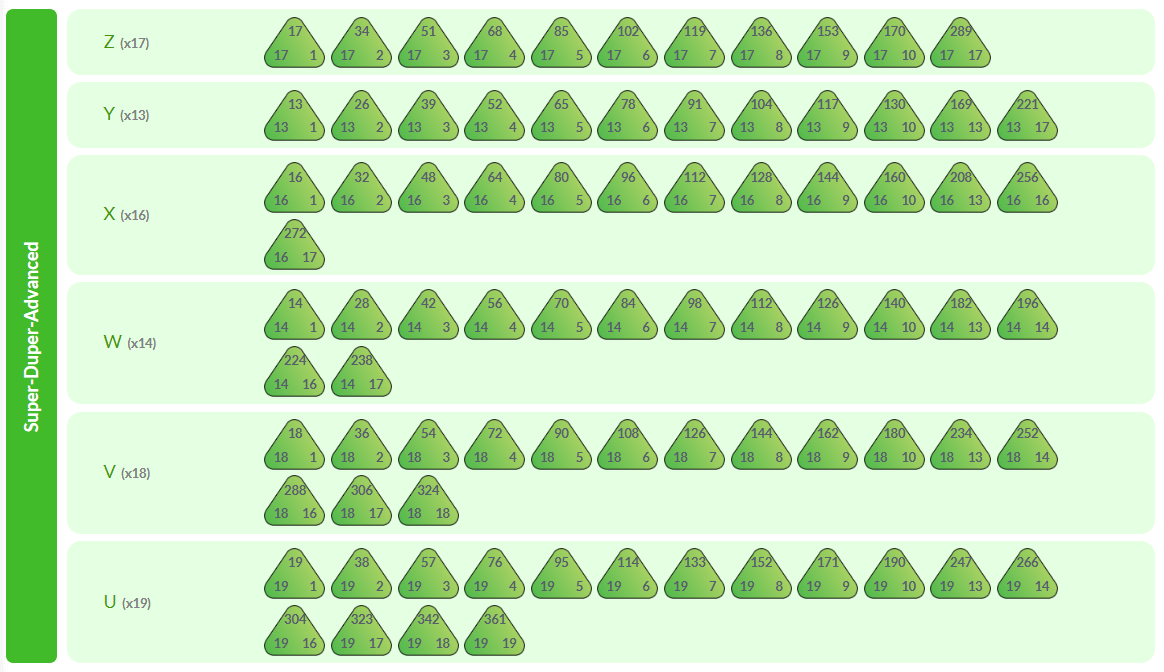
Super-duper-advanced multiplication challenges even the most capable students (and their teachers) by helping them to efficiently solve x19, x18, x14, x16, x13 and x17 facts, also up to __x20.
A graduate of these three advanced programs should be able to efficiently accurately and flexibly solve any multiplication problem up to 20x20!
What Makes MathFactLab Unique?
What most separates us from the pack is that MathFactLab takes a strategy-based approach. While other math fact sites expect students to memorize the facts through drill (a practice proven to be ineffective), our students develop true math fact fluency through focused practice with multiple strategies and a variety of models at each level of the program.
[I]t is through the application of strategies that a student develops fluency, and it is through the use of strategies that students come to know their basic facts, or develop automaticity."
- Jennifer Bay-Williams & Gina Kling in Math Fact Fluency: 60 Games and Assessment Tools to Support Learning and Retention, 2019
"Research supports the use of explicit strategy instruction as effective in helping all students learn (and remember) their basic math facts (e.g., Baroody, et al., 2009; Baroody, et al., 2016; Thornton, 1978; Fuson, 1992; Rathmell, 1978; Thornton & Toohey, 1984)."
- John A. Van de Walle, Karen S. Karp & Jennifer Bay-Williams in Elementary and Middle School Mathematics: Teaching Developmentally, 2019
This blog was written by Mike Kenny, fifth-grade math teacher and creator of MathFactLab.